
A secured credit card is backed by a refundable deposit (usually $200–$500) that becomes your credit limit and acts as collateral — so approval is easy even with no or bad credit. You use it like any card, and it reports to all three credit bureaus, so on-time payments build your credit. Most people see 60–100 point gains within 12 months. After 6–18 months of responsible use, many cards graduate you to an unsecured card and return your deposit. It's a temporary stepping stone, not a permanent card.
What a Secured Credit Card Is
A secured credit card is a credit card backed by your own money. You put down a refundable security deposit — typically $200 to $500 — and that amount usually becomes your credit limit. The issuer holds your deposit as collateral, which dramatically lowers their risk. That's the whole reason approval is within reach even if your credit history is thin, limited, or damaged.
Aside from the deposit, a secured card behaves exactly like a regular (unsecured) credit card. You make purchases up to your limit, you get a monthly statement, and you pay the bill. Crucially, the issuer reports your activity to the three major credit bureaus — and that reporting is what builds your credit over time. About 62 million Americans have a "thin" credit file, and secured cards are one of the most accessible tools for fixing that.
Secured card ≠ prepaid debit card. They both involve putting money down, but they're completely different. With a secured credit card, your deposit is collateral and you're actually borrowing on a credit line when you spend — which gets reported and builds credit. A prepaid debit card just spends money you've loaded; there's no borrowing and no credit reporting, so it does nothing for your credit. If your goal is building credit, you need a secured credit card.
How a Secured Credit Card Builds Credit
A secured card builds credit the same way any credit card does — by reporting your behavior to Equifax, Experian, and TransUnion. The two factors that matter most map directly to the biggest parts of your FICO score:
- Payment history (35% of your score). Every on-time payment is logged and strengthens your record. This is the single most important thing you can do — pay on time, every time.
- Credit utilization (30% of your score). Keeping your balance low relative to your limit signals responsible use. Aim to use under 30% of your limit, ideally under 10%.
Do those two things consistently and the results come. Many people see credit score increases of 60–100 points within 12 months of responsible secured-card use. For the full picture of how long building takes, see how long it takes to build credit.
The single most important rule: make sure your secured card reports to all three credit bureaus. The best secured cards do — but some lower-quality cards report to only one or none, which defeats the entire purpose. Confirm three-bureau reporting before you apply. A secured card that doesn't report builds nothing.
How a Secured Card Works — Step by Step
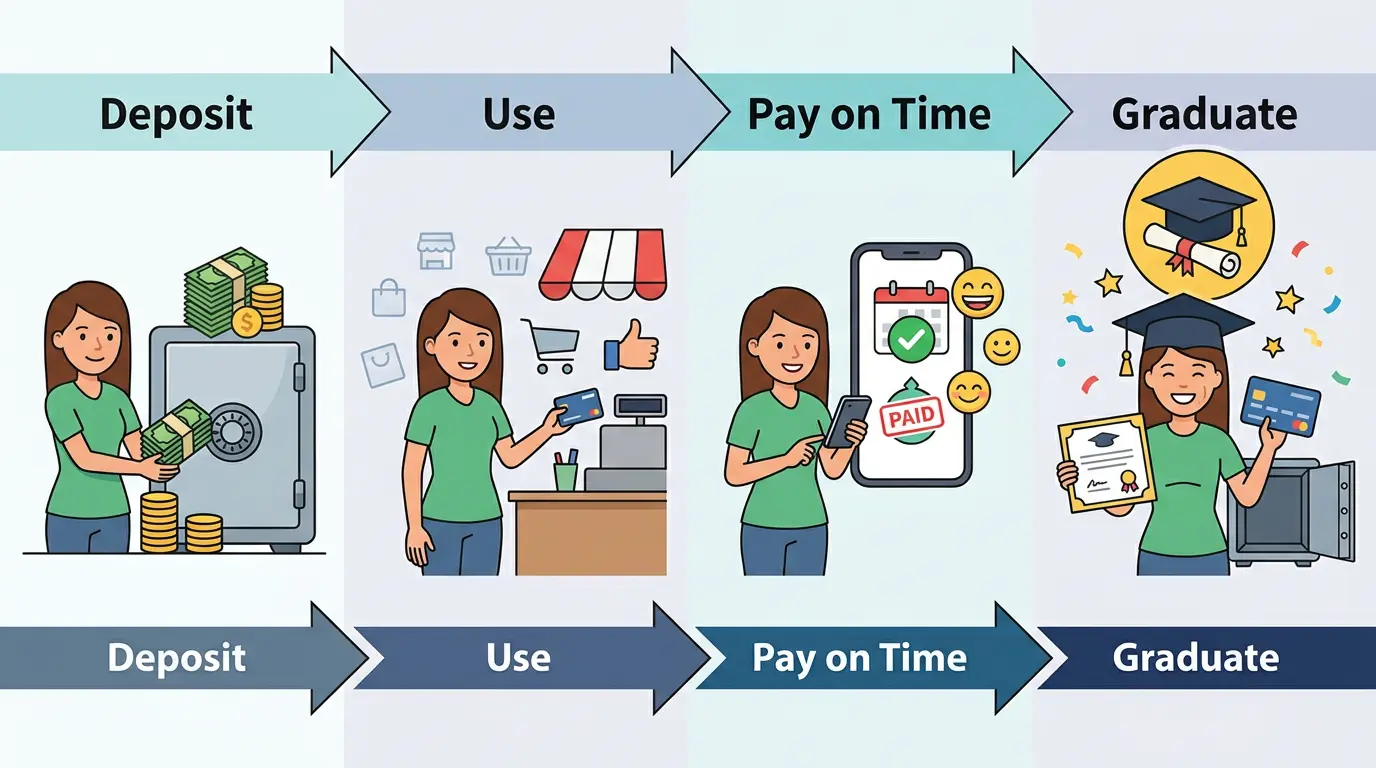
Apply and pay the deposit
You apply (often with only a soft credit check, so no score impact) and pay a refundable security deposit, usually $200–$500. That deposit typically sets your credit limit — deposit $300, get a $300 limit. Some cards let you deposit more for a higher limit.
Use the card for small purchases
Use it like any credit card — but keep spending small and well under your limit. A good approach is putting one or two recurring bills (a streaming subscription, gas) on it and nothing else, so utilization stays low and the balance is easy to pay.
Pay the bill in full and on time
Pay the statement balance in full every month, before the due date. This avoids interest entirely and builds the on-time payment history that drives your score. Set up autopay for at least the minimum as a safety net so you never miss.
Graduate and get your deposit back
After 6–18 months of responsible use, many issuers automatically review your account and upgrade you to an unsecured card — refunding your deposit, often while letting you keep your earned credit history and sometimes the same card. Set a reminder to check upgrade eligibility around the 6-month mark.
Secured vs. Unsecured Credit Cards
| Feature | Secured Card | Unsecured Card |
|---|---|---|
| Security deposit | Required ($200–$500) | None |
| Approval | Easy, even no/bad credit | Based on creditworthiness |
| Credit limit | Usually = deposit | Higher, based on profile |
| Rewards | Limited or none | Often cash back/points |
| Builds credit | Yes (reports to bureaus) | Yes (reports to bureaus) |
| Best for | Building/rebuilding | Established credit |
The takeaway: both build credit identically. The secured card is simply the entry point when you can't yet qualify for an unsecured one. Think of secured cards as training wheels — you use them to prove you're creditworthy, then graduate to unsecured cards for better terms, higher limits, and rewards. You can usually apply for an unsecured card once your score reaches around 620+ with 6+ months of positive history.
Secured Card vs. Subprime Unsecured Card
You may also see "credit-building" unsecured cards aimed at people with bad credit. Be careful: these often charge high annual fees (and sometimes monthly fees) that you never get back. Compare honestly:
A secured card asks for a refundable deposit — your money, returned later. A subprime unsecured card charges non-refundable fees — money gone forever. For most people, tying up a $200 deposit you'll get back beats paying a $75+ annual fee you won't. The exception is someone who genuinely can't spare the deposit cash, in which case a low-fee unsecured builder card or a credit-builder loan may fit better.
How to Choose a Secured Credit Card
What to look for
We don't endorse specific cards, but widely available options in 2026 include secured cards from major issuers like Capital One, Bank of America, and U.S. Bank, plus credit-union and fintech options — several of which graduate to unsecured and even offer modest cash back. Compare current terms directly with issuers before applying, since offers change.
Common Mistakes That Hurt Instead of Help
- Choosing a card that doesn't report to all three bureaus. The most damaging mistake — you build nothing.
- Maxing out the card. A small limit makes it easy to run up high utilization. Keep balances low even though the limit is small.
- Carrying a balance and paying interest. Secured cards often have high APRs. Pay in full monthly — you don't need to carry a balance to build credit (that's a myth).
- Missing payments. A late payment on a credit-building card is especially damaging since you have little other history to cushion it.
- Closing it right after graduating. Keep your oldest accounts open to preserve your length of credit history.
Bottom line: A secured credit card is one of the most effective and accessible ways to build or rebuild credit. Put down a refundable deposit, use the card lightly, pay in full and on time, and confirm it reports to all three bureaus. Within 6–18 months you'll likely graduate to an unsecured card, get your deposit back, and have a real credit history to build on. It's not flashy — it's just one of the few things in personal finance that reliably works.
Frequently Asked Questions
What is a secured credit card?
A credit card backed by a refundable security deposit you pay upfront, usually $200–$500, which typically becomes your credit limit and acts as collateral. That's why approval is easy even with no or bad credit. Otherwise it works like a regular card — you spend, get a bill, and pay it. It reports to the three credit bureaus, so responsible use builds credit. Your deposit is refunded when you graduate to an unsecured card or close in good standing.
How does a secured credit card build credit?
The same way any card does — by reporting to Equifax, Experian, and TransUnion. On-time payments build your payment history (35% of your score), and keeping balances low helps utilization (30%). Paying on time every month is the most important habit. Many people see 60–100 point gains within 12 months. Make sure your card reports to all three bureaus — the best ones do.
Do you get your deposit back on a secured credit card?
Yes — it's refundable. You get it back when you upgrade to an unsecured card with the issuer or close the account in good standing with no balance. Many issuers automatically review after 6–18 months and, if you qualify, upgrade you and return the deposit, sometimes keeping the same card. It's not a fee — it's your money held as collateral, which is a big advantage over subprime cards with non-refundable annual fees.
What is the difference between a secured and unsecured credit card?
The deposit. A secured card requires a refundable deposit ($200–$500) that becomes your limit and acts as collateral, so approval is easy with no/bad credit. An unsecured card needs no deposit and approval is based on creditworthiness, offering higher limits, rewards, and lower fees. Secured cards are a temporary stepping stone — use one for 6–18 months, then graduate to unsecured and get your deposit back. Both build credit the same way.
How is a secured credit card different from a prepaid debit card?
Both require money upfront but work differently. With a secured credit card, your deposit is collateral and you borrow on a credit line when you spend — that borrowing is reported and builds credit. With a prepaid debit card, you just spend money you've loaded; there's no credit line, no borrowing, and no credit reporting, so it does nothing for your credit. To build credit, you need a secured credit card, not a prepaid card.
Sources & References
- Chime — Best Secured Credit Cards 2026: $200+ deposits, 6–12 month upgrade review, three-bureau reporting
- Bankrate — Best Secured Credit Cards (June 2026): graduation to unsecured, deposit vs annual-fee comparison
- FinanceBuzz — 2026 Guide to Secured Credit Cards: secured vs prepaid, deposit as collateral
- Firstcard — Secured vs Unsecured Cards 2026: 6–18 month graduation, apply unsecured at 620+
- WalletHub — Secured Cards That Graduate to Unsecured: deposit refund on graduation
- Capital One — Secured vs Unsecured Credit Cards: the security deposit difference