
You can get out of debt without bankruptcy through several paths: self-managed payoff (avalanche or snowball method — no fees, no credit damage, best if accounts are current); debt management plan through a nonprofit credit counselor (lowers interest rates, one monthly payment, 3–5 years, no credit score requirement); debt consolidation loan or balance transfer (combines debts at a lower rate, preserves credit if you qualify); or debt settlement (reduces total owed but damages credit — last resort before bankruptcy). Start with a free consultation from a nonprofit credit counseling agency.
Why Most People Don't Need Bankruptcy
Bankruptcy filings reached 574,314 cases in 2025 — an 11% increase from 2024 and a 26.8% jump from 2023, according to U.S. Bankruptcy Courts data. The rise reflects genuine financial pressure on American households. But bankruptcy is a drastic step with severe, long-lasting consequences: a Chapter 7 filing stays on your credit report for 10 years, and the process requires court filing fees and often an attorney.
Federal law actually requires anyone considering bankruptcy to speak with a credit counselor first — specifically to determine whether a better option exists. That conversation, usually free at a nonprofit agency, often reveals a path that resolves the debt without the courthouse. The alternatives below are ordered roughly from least to most disruptive to your credit.
Option 1 — Self-Managed Debt Payoff
If your accounts are still current and you have some disposable income each month, a self-managed payoff is the best option — it costs nothing, protects your credit, and you repay what you owe in full. Two proven methods: the debt avalanche (pay the highest-interest debt first to minimize total interest) and the debt snowball (pay the smallest balance first for faster motivational wins).
Advantages
- No fees, no third party, complete control
- Protects and often improves your credit score
- You repay in full — no tax consequences or settlement marks
Drawbacks
- Requires disposable income to accelerate payoff
- Slower than settlement if you owe a lot relative to income
- Requires discipline over months or years
Full guides: Debt Snowball vs Avalanche, How to Get Out of Debt Fast, and How to Pay Off Credit Cards Fast.
Option 2 — Negotiate With Creditors Directly
Many people don't realize creditors will often work with them directly — for free. Call your creditor, explain your financial situation honestly, and ask what hardship options they offer. Creditors may lower your interest rate, set up a temporary hardship repayment plan, waive fees, or even accept a reduced settlement — because recovering something is better than nothing if you file bankruptcy.
Advantages
- No fees — you keep what a settlement company would charge
- Can lower rates or set up hardship plans while keeping accounts current
- Always worth trying before paid options
Drawbacks
- No guarantee — depends on creditor policies
- Requires you to make the calls and follow up
- Settlement offers may still hurt credit if accounts are delinquent
Always get any agreement in writing before making a payment. Verbal agreements with collectors are difficult to enforce.
Option 3 — Debt Management Plan (DMP)
A debt management plan is offered by nonprofit credit counseling agencies. A counselor negotiates with your creditors to lower your interest rates and waive certain fees, then consolidates your debts into one monthly payment you make to the agency, which distributes it to creditors. There's no credit score requirement to enroll, making it accessible when consolidation loans aren't.
Advantages
- Lower interest rates negotiated for you
- One simple monthly payment
- No credit score requirement to enroll
- Nonprofit guidance and budgeting support
Drawbacks
- Small startup and monthly fees
- Credit card accounts usually closed during the plan
- Requires consistent payments for 3–5 years
Find a reputable nonprofit counselor through the National Foundation for Credit Counseling (NFCC.org) or Money Management International (MMI). The initial consultation is free.
Option 4 — Debt Consolidation Loan or Balance Transfer
Debt consolidation combines multiple debts into a single loan or balance transfer at a lower interest rate. A personal consolidation loan at 8–12% APR replaces credit cards at 21%+. A 0% balance transfer card eliminates interest entirely for 12–21 months. This preserves your credit, lets you repay in full, and simplifies payments to one per month.
Advantages
- Lower interest saves thousands over the payoff period
- One predictable monthly payment with a fixed payoff date
- Preserves credit — no settlement or bankruptcy mark
Drawbacks
- Requires decent credit (typically 670+) to qualify for a good rate
- Risk of running cards back up after consolidating
- Balance transfer reverts to high APR if not paid in intro period
Full guide: How to Consolidate Credit Card Debt — 5 Methods Compared.
Option 5 — Debt Settlement
Debt settlement involves negotiating to pay less than the full amount owed — sometimes saving up to 80% of the balance. It can be done yourself or through a settlement company. It's most appropriate for people already behind on payments who genuinely can't catch up. In January 2026, the average person enrolling in a debt settlement program had a FICO score of 593 and enrolled debt of $25,843.
Advantages
- Can dramatically reduce the total amount owed
- Faster resolution than full repayment
- Avoids bankruptcy's court process and 10-year mark
Drawbacks
- Significant credit damage — settled accounts marked 7 years
- Usually requires stopping payments (generating late marks)
- Forgiven debt over $600 may be taxable income
- For-profit companies charge 15–25% of settled debt
Caution on for-profit settlement companies: Many charge high fees and require you to stop paying creditors while they negotiate — which tanks your credit and can lead to lawsuits. A nonprofit debt resolution plan (like MMI's) offers a lower-cost, more transparent alternative. Always try negotiating directly with creditors first.
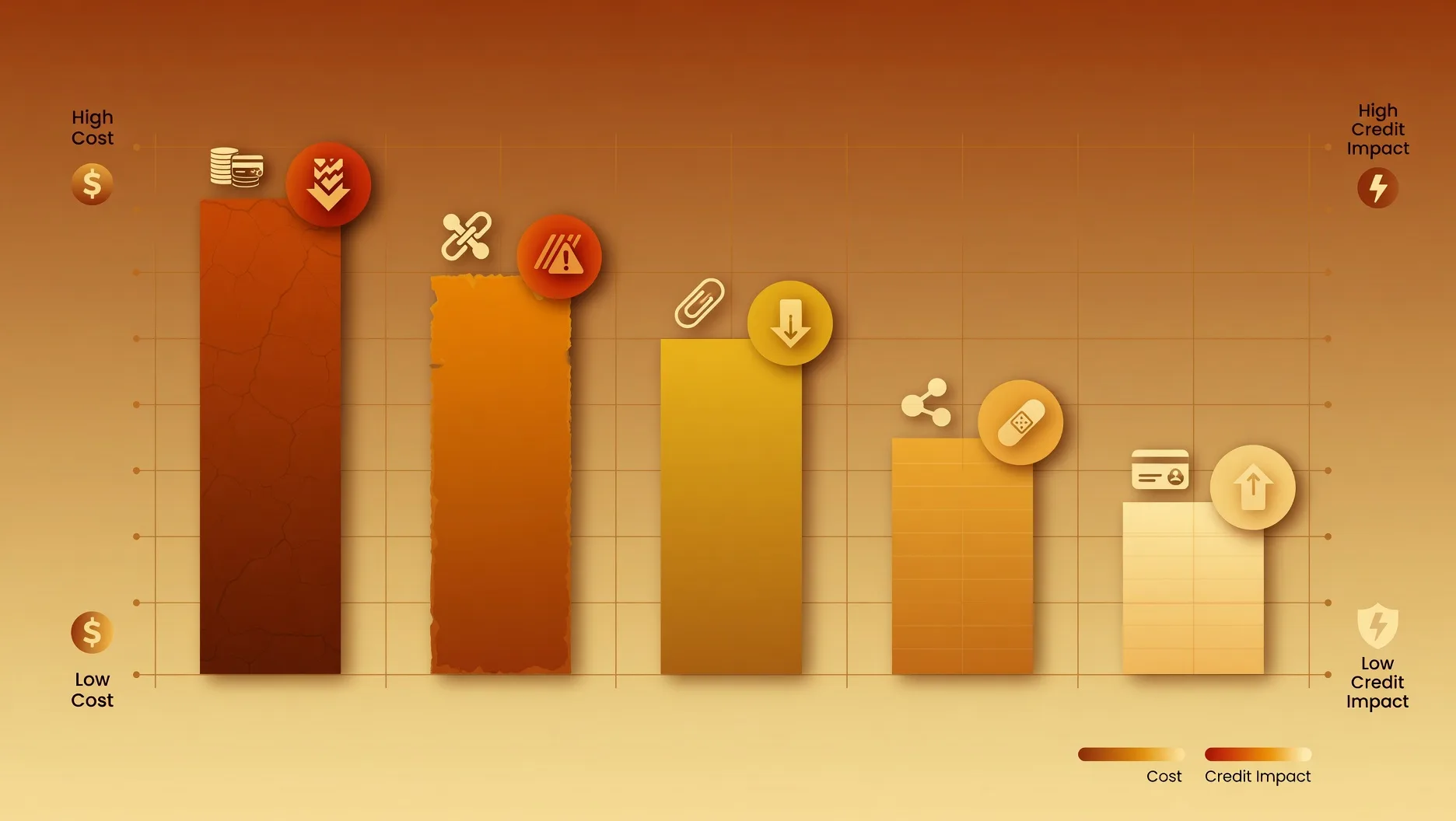
Comparison — All Debt Relief Options at a Glance
| Option | Cost | Credit impact | Timeline | Best for |
|---|---|---|---|---|
| Self-payoff | $0 | Positive | 1–5 yrs | Current accounts + income |
| Negotiate directly | $0 | Varies | Immediate | Everyone — try first |
| Debt management plan | Small fees | Mild | 3–5 yrs | High credit card debt |
| Consolidation loan | Loan interest | Neutral+ | 2–5 yrs | Decent credit (670+) |
| Debt settlement | 15–25% | Significant | 2–4 yrs | Already behind, can't catch up |
| Bankruptcy | Court + attorney | Severe (10 yrs) | 3 mo–5 yrs | Repayment impossible |
Which Option Is Right for You?
Match your situation to the right path
Start here regardless of your situation: Book a free consultation with a nonprofit credit counseling agency through the NFCC (National Foundation for Credit Counseling) at NFCC.org. They'll review your full financial picture at no cost and help you understand which option genuinely fits — without the sales pressure of for-profit debt relief companies. This is the same counseling that bankruptcy law requires filers to complete, and it often reveals a better path.
What to Avoid
The debt relief space is full of predatory operators. Protect yourself from these traps:
- Companies that charge fees before settling anything. It's illegal for debt settlement companies to charge upfront fees before they settle a debt. Walk away from any company that demands payment first.
- "Debt relief" that's actually a high-interest loan. Read carefully — some offers marketed as debt relief are just new loans at bad rates that deepen the hole.
- Guarantees to "erase" your debt or "government programs" that wipe out debt. There is no secret government program that eliminates consumer debt. These are scams.
- Pressure to stop paying creditors immediately. While settlement sometimes requires this, a legitimate counselor explains the full credit consequences first. High-pressure tactics are a red flag.
Frequently Asked Questions
What is the best way to get out of debt without filing bankruptcy?
It depends on your situation. If accounts are current and you have disposable income, self-managed payoff (avalanche or snowball) avoids all fees and credit damage. For high credit card debt, a nonprofit debt management plan lowers interest rates — typically clearing debt in 3–5 years. If you're already behind and can't catch up, debt settlement may reduce the total but damages credit. Always start with a free nonprofit credit counseling consultation.
What is a debt management plan?
A DMP is offered by nonprofit credit counseling agencies. The counselor negotiates lower interest rates and waived fees with your creditors, then consolidates your debts into one monthly payment to the agency, which pays your creditors. There are small fees but no credit score requirement to enroll. Most people pay off debt within 3–5 years. Accounts are typically closed during the plan, which can temporarily affect credit.
Does debt settlement hurt your credit?
Yes. Debt settlement damages your credit because you pay less than owed, and the process usually requires stopping payments while negotiating — generating late marks. Settled accounts are marked "settled for less than full balance," which stays on your report for 7 years. It can resolve debts for a fraction of what's owed (sometimes up to 80% savings), but the credit damage is real. It's generally a last resort before bankruptcy.
Is debt consolidation better than bankruptcy?
For most people who qualify, yes. Consolidation preserves your credit, avoids the 7–10 year bankruptcy mark, and lets you repay in full at a lower cost. It works best with decent credit (670+) and enough income for the consolidated payment. Bankruptcy erases or restructures debt through court but causes severe, long-lasting credit damage. Consolidation is preferable when you can realistically repay; bankruptcy is for when repayment is genuinely impossible.
Can I negotiate with creditors myself?
Yes. You can contact creditors directly and negotiate without paying a third party. Many will lower your rate, set up a hardship plan, or settle for less — especially if you're behind, because they'd rather recover something than nothing in bankruptcy. Call, explain your situation honestly, and ask what hardship or settlement options they offer. Get any agreement in writing before paying. This avoids the 15–25% fees settlement companies charge.
Sources & References
- Debt.org — Bankruptcy Statistics 2026 (574,314 filings in 2025, up 11% from 2024; credit counseling required before filing)
- NerdWallet — How to Pay Off Debt: Top Strategies for 2026 (DMP timeline 3–5 years, no credit score requirement)
- Freedom Debt Relief — Debt settlement enrollment data January 2026 (average FICO 593, enrolled debt $25,843)
- Money Management International — Alternatives to Bankruptcy (nonprofit debt resolution, creditor negotiation)
- Debt.com — Debt Settlement Guide 2026 (settlement can save up to 80%; credit impact)
- U.S. Bankruptcy Courts — bankruptcy filing statistics, 12-month period ending March 31, 2026
- National Foundation for Credit Counseling — NFCC.org — free nonprofit credit counseling