
To get out of debt fast: stop adding new debt immediately, build a $1,000 emergency fund first, then direct every extra dollar to your highest-interest debt (avalanche method) or smallest balance (snowball method). Lower your interest rate through balance transfers or consolidation loans. Add income temporarily with a side hustle. Use windfalls — tax refunds, bonuses — entirely for debt. The math is unambiguous: making only minimum payments at 22% APR on a $6,000 balance takes 22 years. Paying $400/month pays it off in 18 months.
How to Get Out of Debt Fast — The Real Numbers in 2026
Debt is America's most popular financial problem in 2026. According to Motley Fool Money's New Year Money Resolutions Report, 25% of Americans say paying off debt is their #1 financial goal — making it the most common money resolution nationwide. Within that group, 37% are specifically targeting credit card debt first.
The minimum payment trap is the central problem. NerdWallet's January 2026 analysis found that with a $11,400 balance at 23% APR (the average for those carrying revolving debt), making only minimum payments results in $18,500 in interest charges and a payoff date 22 years from now. Over a quarter of Americans with revolving debt only make minimum payments each month. That's the definition of staying in debt forever.
The 9 steps below are ordered for maximum impact and speed — not for how comfortable they feel. Some of them are hard. All of them work.
Step 1 — Build a Complete Debt Inventory Before Anything Else
List every single debt with balance, rate, and minimum payment
You cannot make a plan without knowing exactly what you're dealing with. Most people have a vague sense of how much they owe — but vague doesn't pay off debt. Sit down with your bank statements, credit card statements, and loan documents and build a complete inventory.
For each debt, record:
- Creditor name
- Current balance
- Interest rate (APR)
- Minimum monthly payment
- Due date
Add up all balances for your total debt number. Add up all minimum payments to find your minimum monthly obligation. Then calculate your total monthly interest cost: this is the number that shows you how much money you're losing every month you stay in debt.
According to Experian data, the average American carries $104,755 in total debt including mortgages, auto loans, student loans, and credit cards. Credit cards alone average $6,735 per person carrying a balance. Knowing your real number — not an approximate — is step one.
Step 2 — Stop Adding New Debt Immediately
Freeze or remove your credit cards before attacking existing balances
This step seems obvious. It's the one most people skip. Attempting to pay off debt while continuing to add new charges is like bailing out a boat without plugging the hole — you work hard and go nowhere.
Put your credit cards in a drawer. Unlink them from your online shopping accounts. For the next 3–6 months, use cash or a debit card for all discretionary spending. This is temporary — you're not giving up credit forever, just long enough to make real progress.
The data shows why this matters: 47% of Americans with revolving credit card debt say their debt is likely to increase in 2026, according to NerdWallet's survey. Most of that increase will come from continuing to use the same cards they're trying to pay off.
Step 3 — Build a $1,000 Emergency Fund Before Aggressive Payoff
Save $1,000 first — this prevents debt from coming back
This step counterintuitively delays your debt payoff by a few weeks — and saves you months of setbacks. Without a cash buffer, every unexpected expense (car repair, medical bill, home issue) goes directly back onto a credit card. You pay off $400, have a $350 car repair, and your balance goes right back up.
A $1,000 emergency fund breaks this cycle. It's not your full 3–6 month emergency fund — that comes later. It's just enough to handle the most common financial surprises without touching credit cards.
Open a separate high-yield savings account for this fund. Keep it at a different bank so you're not tempted to spend it. Once you hit $1,000, switch all your focus to aggressive debt payoff.
Step 4 — Choose Your Payoff Strategy: Avalanche or Snowball
Debt avalanche saves the most money — debt snowball builds the most momentum
Both methods work. The difference is in what they optimize for. Choose based on your psychology, not just the math.
Debt Avalanche — pay highest interest rate first: While paying minimums on all other debts, direct every extra dollar to the account with the highest APR. When that's paid off, roll those payments to the next highest rate. This saves the maximum amount in interest over time.
Debt Snowball — pay smallest balance first: While paying minimums on all other debts, direct every extra dollar to the smallest balance. When it's gone, roll those payments to the next smallest. This produces faster early wins and stronger psychological momentum.
| Method | Best for | Saves most money | Fastest wins |
|---|---|---|---|
| Debt Avalanche | High interest rate differences | Yes — mathematically optimal | No |
| Debt Snowball | Multiple small balances, needs motivation | No — pays more interest | Yes |
Research from Harvard Business Review found that the debt snowball is more effective for many people in practice — not because it's mathematically superior, but because early wins sustain motivation long enough to reach the finish line. The best method is the one you'll actually follow for 2–5 years.
For more on this decision, see our detailed comparison: Debt Snowball vs Debt Avalanche — which method actually works?
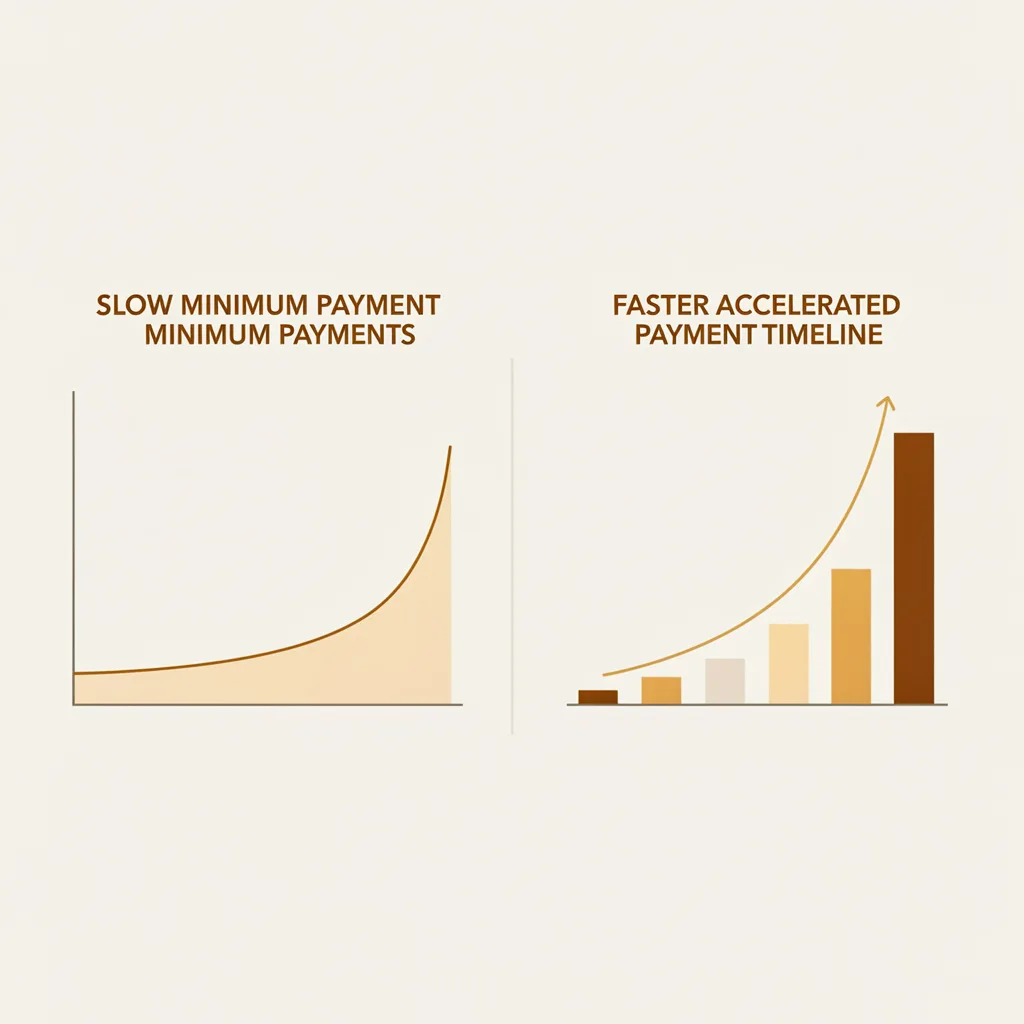
Step 5 — Pay More Than the Minimum — Even by $50
Extra payments have an exponential effect on your payoff timeline
The math on extra payments is striking. NerdWallet's analysis found that adding just $50 to your minimum payment each month cuts total interest almost in half and significantly reduces the payoff timeline.
The math — $6,000 balance at 22% APR
Minimum payments only: ~$135/month → pays off in 22+ years → $14,000+ in interest
Minimum + $50 extra: ~$185/month → pays off in 6 years → ~$7,500 in interest
Fixed $300/month: → pays off in 27 months → ~$1,900 in interest
Fixed $400/month: → pays off in 18 months → ~$900 in interest
Every extra dollar you put toward debt at 22% APR delivers a guaranteed 22% return. No investment reliably beats that.
Step 6 — Aggressively Lower Your Interest Rate
A lower interest rate means more of every payment attacks principal
You can work just as hard paying $300/month and get dramatically different results depending on your interest rate. Lowering your rate is one of the highest-leverage moves available.
Three ways to lower your rate:
- Call your credit card issuer and ask. This is underutilized. If you have a history of on-time payments, call the number on the back of your card and ask for a rate reduction. About 70% of cardholders who call and ask receive some reduction, according to a LendingTree survey. It takes 10 minutes and costs nothing.
- Transfer to a 0% APR balance transfer card. With good credit (670+), you can move your balance to a card with 0% intro APR for 12–21 months. On a $6,000 balance, switching from 22% to 0% and paying $400/month saves over $1,500 in interest and pays off the balance 5 months earlier. See our full breakdown of how to consolidate credit card debt with balance transfers.
- Consolidate with a personal loan. If your credit score qualifies, a personal consolidation loan at 10–12% APR cuts your interest cost by half compared to 22% credit cards, with a fixed monthly payment and a clear payoff date.
Step 7 — Cut Expenses and Redirect Every Dollar to Debt
Find $200–$400/month in cuts and direct it entirely to your target debt
The fastest debt payoff comes from maximizing the extra payment amount, and that requires finding money in your current budget. Even $200–$300 extra per month can cut years off a repayment timeline.
Fastest places to find money:
- Subscriptions you forgot about. The average American has 4.5 paid subscriptions they don't actively use. Audit your bank and credit card statements for recurring charges. Cancel everything you haven't used in the last 30 days.
- Dining out reduction. Americans spend $3,600/year on restaurant meals on average (BLS, 2025). Cutting dining out by half saves $150/month with no meaningful quality-of-life impact if you cook the same meals at home.
- Grocery savings. See our guide to saving money on groceries — meal planning and store-brand swaps alone save $100–$200/month for most households.
- Negotiating existing bills. Car insurance, phone service, and internet plans are negotiable. Spending 30 minutes shopping competing quotes and calling your current provider often reduces monthly bills by $50–$150 combined.
The key rule: every dollar cut from expenses goes directly to debt. Not into checking where it's available for spending. Directly to the target debt balance the same day you identify the saving.
Step 8 — Add Temporary Income and Direct 100% to Debt
A 3–6 month income boost can eliminate thousands in debt immediately
Cutting expenses is limited — there's only so much to cut. Adding income has no ceiling. A temporary income boost of $500–$1,000/month for 6 months eliminates $3,000–$6,000 in debt that would otherwise take years to pay off.
Fastest ways to add income temporarily:
- Sell things you own. Electronics, furniture, clothing, sporting equipment, tools. A determined weekend of selling on Facebook Marketplace or eBay typically generates $300–$800. That money can come in within days.
- Take on freelance work. One well-chosen freelance project at your existing skill level can generate $500–$2,000. See our guide on how to start freelancing from home.
- Work overtime or pick up extra shifts. If your job offers this option, 4–8 extra hours per week for 3 months adds meaningful income without requiring new skills.
- Gig economy work. Delivery services, rideshare, task-based platforms. These offer flexible hours and immediate payment — useful for adding specific extra income to one monthly debt payment.
The rule: Every dollar of extra income from temporary sources goes directly to debt — not into your checking account budget. If it hits your checking account first, it gets spent. Transfer it to your debt payment the same day you receive it.
Step 9 — Use Every Windfall Entirely for Debt
Tax refunds, bonuses, and gifts are debt payoff opportunities in disguise
The average federal tax refund in 2026 is approximately $3,500. Most people spend it. People paying off debt use it to eliminate or significantly reduce one account entirely.
For someone with a $3,500 target debt balance, a tax refund eliminates it in one payment. For someone with a $7,000 balance, it cuts it in half — reducing both monthly interest cost and the remaining payoff timeline dramatically.
The same logic applies to any unexpected money: work bonuses, birthday gifts, inheritance, insurance settlements. The standard personal finance advice is to "treat yourself" with part of a windfall. When you're in high-interest debt, every dollar of windfall money you spend instead of applying to debt costs you the equivalent of that dollar plus 22% per year for however many years it would have taken to pay off. That's the true cost of a splurge.
Wait until after the debt is gone to celebrate. The celebration is permanent — it's called financial freedom.
How Long Will It Actually Take? Realistic Timelines
| Total debt | Monthly payment | Interest rate | Payoff timeline | Total interest |
|---|---|---|---|---|
| $6,000 | Minimum only | 22% | 22+ years | $14,000+ |
| $6,000 | $200/month | 22% | 3.5 years | $2,400 |
| $6,000 | $400/month | 22% | 18 months | $900 |
| $6,000 | $400/month | 0% (balance transfer) | 15 months | $0 + transfer fee |
| $15,000 | $500/month | 22% | 4 years | $9,000 |
| $15,000 | $500/month | 12% (consolidation loan) | 3.5 years | $3,800 |
Frequently Asked Questions
How fast can you realistically get out of debt?
It depends on your total debt, income, and payment aggression. For the average $6,000 balance at 22% APR: minimum payments take 22+ years. Paying $400/month clears it in 18 months. Adding a side hustle and directing it entirely to debt can eliminate $6,000 in 12–18 months with focused effort. Most people who commit fully can eliminate credit card debt in 2–5 years regardless of starting balance.
Should I pay off debt or save money first?
Build a $1,000 starter emergency fund first, then attack high-interest debt aggressively, then build a full 3–6 month emergency fund. Without the starter fund, every unexpected expense forces you back onto credit cards and undoes your progress. Once high-interest debt is gone, redirect those payments to savings and investments.
What is the fastest way to pay off credit card debt?
Transfer to a 0% APR balance transfer card (saves immediate interest), pay as much as possible each month, and add temporary income to direct more toward the balance. On a $6,000 balance at 22% APR, switching to 0% APR and paying $400/month pays off in 15 months saving over $1,500 in interest — versus 18 months at the original rate with $900 in interest.
Is it better to pay off debt or invest?
Always pay off high-interest debt first. At 22% APR, paying off credit card debt delivers a guaranteed 22% return — no investment reliably beats that. The general rule: pay off any debt above 7% before investing beyond your employer's 401(k) match. Always capture the full employer match first — it's an immediate 50–100% return. Once high-interest debt is eliminated, shift to investing.
Will paying off debt hurt my credit score?
Paying off debt almost never hurts your credit score and usually improves it. Reducing credit card balances lowers your utilization ratio (30% of FICO score) — which typically raises your score within one billing cycle. The one exception: closing a paid-off credit card can slightly hurt your score by reducing available credit. Keep paid-off accounts open with zero balance unless there's an annual fee.
Sources & References
- Motley Fool Money — 2026 New Year Money Resolutions Report (25% prioritize debt payoff; 37% targeting credit cards)
- NerdWallet — 2025 Household Credit Card Debt Study, January 2026 ($11,400 avg balance at 23% APR = 22 years minimum payments)
- Experian — Consumer Credit Review 2025 (average credit card balance: $6,735; total consumer debt: $104,755)
- Federal Reserve — G.19 Consumer Credit Report, Q1 2026 (average credit card APR: 22%)
- CFPB — Debt management and credit counseling resources
- NFCC — National Foundation for Credit Counseling — find certified counselors
- Bureau of Labor Statistics — Consumer Expenditure Survey, 2025 ($3,600/year average restaurant spending)