
To save money fast: cancel unused subscriptions today (saves $50–$150/month immediately), sell items you own this weekend ($300–$800 in days), switch to a high-yield savings account earning 4–5% APY instead of 0.38%, and set up automatic savings on payday before you can spend it. These four moves combined can generate $500–$1,000 in 30 days without changing your job or taking on side work. The key: treat savings like a bill — automatic and non-negotiable.
How to Save Money Fast — Why Americans Struggle to Save in 2026
The personal saving rate in the United States dropped to 4.5% of disposable income as of January 2026, according to the Bureau of Economic Analysis — well below the 8–10% most financial advisors recommend. The rate averaged just 4.72% across all of 2025, down from 5.43% in 2024.
The 12 moves below are ordered by speed — how quickly each one actually produces cash in your savings account. Some work in minutes. Some take a few days. None require a higher income. All of them work when applied consistently.
Moves That Work Immediately — Days 1 to 7
This is the fastest money-saving move available. Log into your bank account and credit card statements right now. Make a list of every recurring charge — monthly and annual. Cancel every service you haven't actively used in the last 30 days.
The average American pays for subscriptions they've forgotten about. Streaming services, software, app subscriptions, gym memberships, box subscriptions, and annual renewals accumulate invisibly. Many people find $50–$150 per month in charges they weren't thinking about.
Most people have $300–$800 worth of unused items sitting in their home. Electronics, furniture, clothing, sporting equipment, books, kitchen gadgets, tools. List them on Facebook Marketplace (fastest for local pickup), eBay, or Poshmark for clothing.
A focused Saturday afternoon of photographing and listing items typically generates several hundred dollars within a week. This requires zero change to your ongoing spending habits — it's one-time cash from assets you already own.
If your savings are in a traditional bank account earning the national average of 0.38% APY, you are losing money relative to what's available. High-yield savings accounts currently pay 4–5% APY — more than 10 times higher — for the same money, same FDIC insurance, and same access.
Opening a HYSA at Ally, SoFi, or another online bank takes about 10 minutes. On a $5,000 savings balance, the difference between 0.38% and 4.50% is $206 per year — money you earn automatically by doing nothing more than moving your savings to the right account.
Auto insurance premiums plateaued in 2025 after years of steep increases — which means shopping rates is now more likely to produce savings than it was in 2023–2024. Auto insurance premiums rose just 0.6% in 2025 after a 9% jump in 2024, according to Fidelity research. Drivers who shop competing quotes and switch insurers save an average of $500–$700 per year.
Call your current insurer first and ask them to review your rate for any available discounts — good driver discount, multi-policy bundle, low-mileage discount, defensive driving course completion. If they can't reduce your rate, get competing quotes from two or three other insurers using comparison tools.
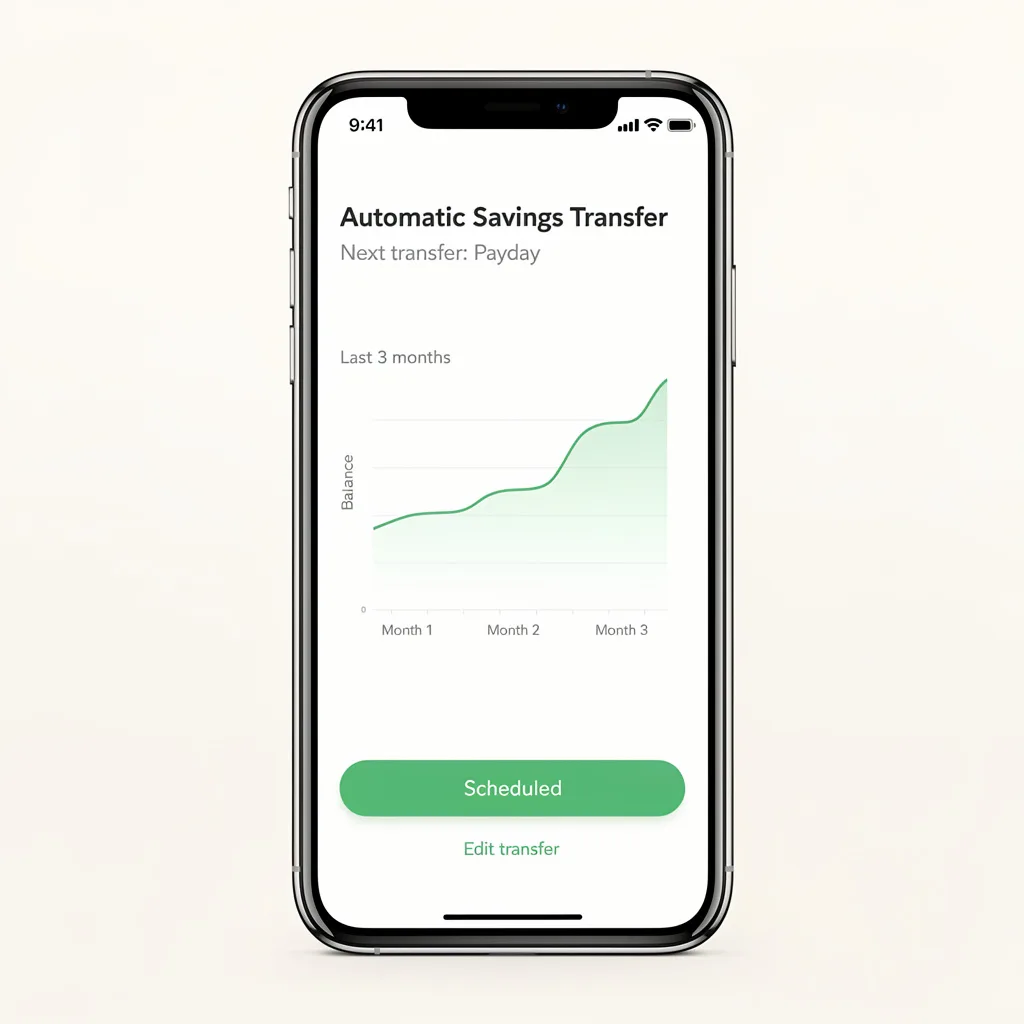
Automation is the single most reliable savings behavior — not because of the amount, but because it removes the decision. Set up an automatic transfer from your checking account to your savings account for the day after each paycheck deposits. Even $50 per paycheck adds $1,300 per year without ongoing effort.
The psychology is critical: money that moves before you see it is money you don't spend. Nearly 2 in 5 Americans (38%) automate their savings according to Credible's 2025 survey — and they consistently save more than those who save whatever is "left over." There is never anything left over.
Monthly maintenance fees on checking accounts averaged a record $13.95 in January 2026 — $167.40 per year just for having the account. Dozens of genuinely free checking accounts exist at online banks with no monthly fee, no minimum balance, and FDIC insurance. Switching takes 20 minutes and immediately eliminates this cost.
See our full guide to the best free checking accounts of 2026 — all fee-free, no minimum balance required.
Moves That Work Within 30 Days
The average U.S. household spent $667/month on groceries in 2025, according to Empower Personal Dashboard data. Meal planning — deciding exactly what you'll cook before you shop — eliminates the two biggest sources of grocery waste: buying food you don't use and buying food without a plan. Combined with store-brand switches and a discount grocer like Aldi, most households save $100–$200 per month.
Full guide: How to save money on groceries — 14 strategies ranked by impact.
Cable, internet, and phone bills are negotiable — especially if you've been a customer for more than 12 months. Call your provider, tell them you're considering switching, and ask what retention offers are available. Providers often apply promotional rates or match competitor pricing rather than lose a customer.
A 30-minute phone call to your internet provider can reduce your bill by $20–$40/month. The same conversation with your phone carrier can produce $10–$30/month in savings. These aren't guaranteed but succeed often enough that the call is nearly always worth making.
Ibotta, Rakuten, and store loyalty apps offer cash-back on purchases you'd make anyway. Ibotta provides rebates on groceries — scan your receipt after shopping and earn $0.25 to $2.00 on specific items. Active users typically earn $20–$40/month. Rakuten provides 1–15% cash-back on online purchases from thousands of retailers.
These apps require engagement — you have to remember to activate offers and scan receipts. But for purchases you're already making at stores you already use, it's found money with no behavioral change required.
Americans spend an average of $879/month at restaurants, according to Empower Personal Dashboard data. The average restaurant meal costs $35–$50 per person including tip, versus $8–$12 in ingredients for the same meal cooked at home. Replacing one restaurant dinner per week with a home-cooked meal saves $90–$170 per month — without eliminating dining out entirely.
The key is not trying to eliminate dining out entirely (unsustainable) but reducing frequency deliberately. Two restaurant meals per week instead of four is a 50% reduction in that spending — while still enjoying the experience regularly.
For any discretionary purchase above $50, wait 24 hours before buying. Add it to your cart online but don't check out. Write it down on a list if shopping in-store. Return the next day and decide if you still want it. Research consistently shows that the majority of impulse purchases are not made when there's a deliberate pause between wanting and buying.
This doesn't prevent you from buying things you genuinely want — it filters out purchases driven by momentary impulse rather than genuine preference. Most people who implement the 24-hour rule are surprised by how many items they decide not to buy the next day.
Nearly 32 million 401(k) accounts with assets totaling more than $2 trillion have been lost or forgotten by American workers who changed jobs, according to Fidelity research. If you've changed employers in the last decade, you may have a forgotten retirement account you're not managing.
Use the IRS's retirement plan tool or the Department of Labor's Abandoned Plan Search to find old 401(k)s. Also check your state's unclaimed property database — every state maintains a list of unclaimed funds including forgotten bank accounts, insurance policies, and security deposits. The National Association of Unclaimed Property Administrators database at MissingMoney.com searches multiple states simultaneously.
What Happens When You Combine These Moves
| Move | Monthly savings | Speed |
|---|---|---|
| Cancel unused subscriptions | $50–$150 | Immediate |
| Switch to free checking account | $14 | Immediate |
| Meal planning + grocery changes | $100–$200 | Week 1 |
| Automate savings on payday | Variable | Next paycheck |
| Reduce dining out once/week | $90–$170 | Week 1 |
| Negotiate bills (internet, phone) | $30–$70 | Days 1–7 |
| Insurance rate shopping | $40–$60 | Week 1–2 |
| Cash-back apps (Ibotta, Rakuten) | $20–$50 | Ongoing |
| Total combined (conservative) | $344–$714/month | — |
At the conservative end, implementing just five of these twelve moves produces $344/month in savings — $4,128 per year. That's a fully funded $1,000 emergency fund within three months, with money left over for debt payoff or investing.
The automation rule: Don't trust yourself to manually transfer savings each month. Every dollar you save needs to move automatically before it's available to spend. Set up the transfer on the day after each paycheck — or split your direct deposit so a portion goes directly to savings. The people who save consistently are not the ones with the most discipline. They're the ones who made the decision once and let automation do the rest.
Frequently Asked Questions
How can I save $1,000 fast?
The fastest path to $1,000: sell items you own (typical weekend haul: $300–$800), cancel unused subscriptions (typical savings: $50–$150/month), and redirect that money to a separate savings account before the next paycheck. For someone with $200 in subscription savings and $500 from selling unused items, reaching $1,000 is achievable within 30–60 days without changing your income or taking on extra work.
What is the 50/30/20 rule for saving money?
The 50/30/20 rule allocates your take-home pay: 50% to needs (rent, utilities, groceries, transportation, insurance, minimum debt payments), 30% to wants (dining out, entertainment, subscriptions), and 20% to savings and extra debt payments. In high cost-of-living areas, housing alone may consume more than 50%. If 20% is unreachable today, start with whatever percentage you can automate and increase it by 1% every 3 months.
How much should I save each month?
Most financial advisors recommend saving 20% of your take-home income. The national average personal saving rate is 4.5% of disposable income (BEA, January 2026) — far below optimal. The most important number isn't the percentage — it's consistency. Saving $100/month automatically is more valuable than planning to save $500 when you have extra money.
What is the fastest way to save money with a low income?
With a low income, the fastest savings moves are: cancel subscriptions immediately (frees up $30–100/month with zero effort), switch to a free checking account and high-yield savings account, meal plan to cut grocery spending, and automate even $25/paycheck into savings. On a tight income, even $500 in a separate savings account changes your financial resilience significantly.
Is it better to pay off debt or save money?
Build a $1,000 emergency fund first, then aggressively pay off high-interest debt (above 7% APR), then build a full 3–6 month emergency fund. Without any savings buffer, every unexpected expense goes back onto credit cards, undoing your debt payoff progress. Once high-interest debt is eliminated, redirect those payments into savings and investments.
Sources & References
- Bureau of Economic Analysis — Personal Saving Rate, January 2026: 4.5% (released March 17, 2026)
- Credible — American Savings Report 2025 (1 in 5 can't cover $500 emergency; 38% automate savings)
- Fortunly — American Savings Statistics 2026 (73% saving less due to inflation)
- Empower Personal Dashboard — Tracking America's Food Spending 2025 ($667/month groceries; $879/month restaurants)
- Fidelity — 15 Money Saving Tips Spring 2026 (32 million lost 401k accounts; auto insurance up 0.6% in 2025)
- FDIC — National average savings APY: 0.38%, May 2026
- MissingMoney.com — National Association of Unclaimed Property Administrators database