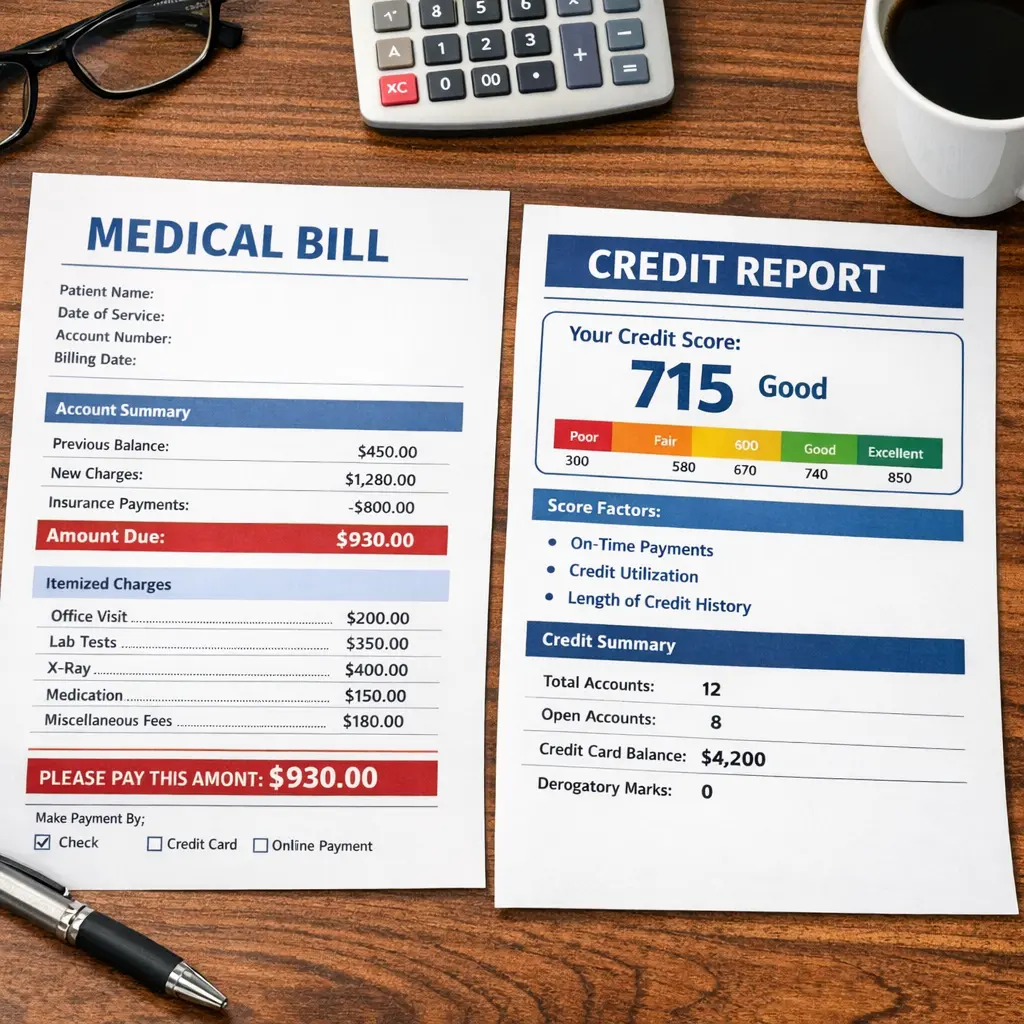
Some medical debt can still appear on your credit report in 2026. A federal rule that would have banned it entirely was finalized in January 2025 but struck down by a court in July 2025 — it's not enforceable. However, the three major bureaus' voluntary 2023 changes remain in effect: paid medical collections are removed regardless of amount, and unpaid medical debt under $500 is never reported. At least 15 states now have their own laws restricting medical debt reporting. Net effect: roughly 70% of medical-debt tradelines have been removed nationally — but unpaid medical debt of $500+ can still show up unless your state bans it.
How We Got Here: A Confusing Timeline
The rules around medical debt and credit reporting have shifted more than once in the past few years, which is exactly why so much outdated information is still floating around. Here's the sequence:
What's Actually On (and Off) Your Report Right Now
✓ Removed / never reported
- Any paid medical collection — regardless of amount or how long it took to pay
- Unpaid medical collections under $500
- Any medical debt banned by your state's own law, if applicable
✗ Can still appear
- Unpaid medical collections of $500 or more
- Debt in states without their own medical-debt protections
- Debt reported before the applicable waiting period has passed
Combined, the bureaus' 2023 voluntary changes and the wave of state laws have removed an estimated 70% of medical-debt tradelines from credit reports nationally — a meaningful majority, but far from all of it. Total U.S. medical debt is roughly $220 billion, and around 41% of adults carry some form of it, according to KFF.
Why the federal rule failed: The court's core reasoning was that the Fair Credit Reporting Act gives consumers the right to dispute inaccurate information but doesn't grant the CFPB authority to ban reporting of an entire category of debt based on its origin. It's a legal/procedural ruling, not a judgment that medical debt reporting is fair — which is exactly why the political and legislative fight has moved to individual states.
Does Your State Protect You?
As of early 2026, at least 15 states have passed their own laws restricting or banning medical debt from appearing on residents' credit reports — a patchwork that keeps growing as more states introduce similar bills. Protections vary significantly: some states ban medical debt reporting outright, others limit it to certain dollar thresholds or require extra verification steps before a medical collection can be reported. Because this list changes as new state laws pass, the most reliable way to know your protections is to check your state's current consumer protection statutes or ask a local legal aid office, rather than relying on a fixed list that may already be outdated by the time you read it.
What to Do If Medical Debt Is on Your Report
Pull your three credit reports
Get them free at AnnualCreditReport.com and check every medical collection against the current rules above. Our guide to reading your credit report walks through what to look for.
Check if it should already be gone
Is it paid? It shouldn't be reported at all. Is the unpaid balance under $500? Same. Either one is grounds for a dispute if it's still showing.
Verify your state's protections
Check whether your state is among those restricting medical debt reporting — you may have additional grounds to dispute beyond the bureaus' national policy.
File a dispute with documentation
Request itemized bills from the provider to confirm accuracy, then dispute directly with the reporting bureau, including proof of payment or your reasoning. The bureau must generally investigate within 30 days. See our guide to disputing credit report errors.
Get ahead of future bills
Negotiate with providers before a bill reaches collections — many hospitals offer interest-free payment plans or financial assistance that prevents reporting altogether. If it's already with a collector, our guide to negotiating debt covers the same tactics.
Don't assume you're covered. Because a federal ban was announced and widely reported before being struck down, many people believe medical debt is automatically excluded from credit reports now. It isn't — unless it's paid, under $500, or protected by your specific state's law. Check your actual reports rather than assuming.
The bottom line: Medical debt reporting in 2026 is a genuine patchwork — no federal ban exists after the court struck one down, but the credit bureaus' 2023 voluntary policy (removing paid debt and unpaid debt under $500) is still fully active, and a growing number of states add further protection on top. The result is that roughly 70% of medical-debt tradelines have disappeared from reports nationally, even without a federal law. Pull your reports, check each medical item against these rules, and dispute anything that shouldn't be there. This is a fast-moving area — new state laws are passing regularly — so it's worth rechecking periodically rather than assuming today's rules are permanent.
Frequently Asked Questions
Is medical debt still on credit reports in 2026?
Yes, some can still appear, though far less than in past years. In January 2025 the CFPB finalized a rule banning essentially all medical debt from credit reports, but a federal court vacated it in July 2025, ruling the CFPB exceeded its authority; as of 2026 the rule isn't enforceable. Despite that, the three major bureaus' voluntary 2023 changes remain fully in effect regardless of the court ruling: paid medical collections no longer appear at all, and unpaid medical collections under $500 aren't reported. At least 15 states as of early 2026 have their own laws restricting medical debt reporting, adding further protection depending on where you live. So less medical debt shows up than a few years ago, but unpaid medical debt of $500+ can still appear unless your state has banned it outright.
What happened to the federal medical debt credit report ban?
In January 2025, the CFPB finalized a rule under Regulation V that would have prohibited credit reporting agencies from including medical debt in reports given to lenders, and barred lenders from considering medical information in credit decisions — an estimated $49 billion in debt affecting 15 million Americans. The rule was challenged in court, and in July 2025 a federal court in the Eastern District of Texas vacated it entirely in Cornerstone Credit Union League v. CFPB, finding the CFPB exceeded its authority under the Fair Credit Reporting Act. As of 2026, there is no nationwide legal ban on medical debt on credit reports, and the rule cannot be enforced. This means you can't assume medical debt is automatically excluded anymore — check your reports directly and understand which protections still apply through bureau policy and state law.
What medical debt protections are still in effect?
Real protections remain because the three major bureaus made their own voluntary changes in 2023 that were never dependent on the CFPB rule and are unaffected by the court's decision. Specifically: paid medical collection debt is no longer reported, regardless of the original balance or how long it took to pay. Unpaid medical debt under $500 isn't reported at all, even if it stays unpaid. There's also a longer waiting period before unpaid medical debt can appear in the first place. Beyond bureau policy, state law is an increasingly important layer: at least 15 states as of early 2026 have passed laws restricting or banning medical debt from credit reports, with more considering similar legislation. Combined, these bureau policies and state laws have removed an estimated 70% of medical-debt tradelines nationally, even without a federal ban.
How do I get medical debt removed from my credit report?
Pull your reports from all three bureaus free at AnnualCreditReport.com and check each medical collection against current rules. If the debt is paid in full, it shouldn't be reported at all under the bureaus' 2023 policy — if it's still showing, that's grounds for a dispute. If the unpaid balance is under $500, same. Also verify whether your state is one of roughly 15 that restrict medical debt reporting, since you may have additional grounds under state law. To dispute, request itemized bills from the provider to verify accuracy, then file a dispute with the reporting bureau with documentation like proof of payment; the bureau generally must investigate and respond within 30 days. It's also worth negotiating directly with providers before a bill reaches collections, since many hospitals offer interest-free payment plans or financial assistance that prevents reporting in the first place.
Sources & References
- NCLC Digital Library — The Latest on Keeping Medical Debt Out of Credit Reports: 2023 bureau changes, CFPB rule vacated July 2025, Cornerstone Credit Union League v. CFPB
- Firstcard — Medical Debt on Credit Reports 2026: rule vacated as exceeding CFPB authority, bureaus' voluntary 2023 changes still in effect
- Health Bill Central — Medical Debt and Credit Reports 2026: ~70% of tradelines removed, 15 states ban medical debt reporting, $220B total medical debt
- Lakeshore Law Center — Medical Debt on Your Credit Report in California: paid/under-$500 removal timeline, state-level protections
- Crowned Credit — Medical Debt on Your Credit Report in 2026: federal rule struck down, state laws filling the gap, dispute strategy
- Consumer Financial Protection Bureau — How to Dispute an Error on Your Credit Report: free dispute process, 30-day bureau investigation window